

Why Growing Retailers Are Rethinking Ecommerce-Centric Checkout
Executive Summary
Retailers evaluating Shopify alongside NetSuite are not choosing between platforms. They are choosing the data architecture that will power retail operations and AI.
Shopify delivers the ecommerce experience, digital merchandising, and online customer engagement.
Zoku POS for NetSuite captures real-time in-store transactions aligned directly with ERP data.
Oracle NetSuite unifies customers, inventory, orders, and financials into a single trusted dataset across the business.
With operational data governed inside NetSuite, retailers can activate NetSuite AI for demand forecasting, inventory optimization, customer intelligence, and financial insight.
Scalable retail and effective retail AI both depend on ERP-aligned POS and unified operational data, not ecommerce-centric checkout alone.
Why Retail Growth Changes POS Requirements
Many retailers begin with Shopify because it enables rapid ecommerce launch, strong merchandising, and simple in-store selling. For early-stage brands and small store networks, this simplicity works well.
As retailers expand into multi-location operations, higher transaction volume, complex inventory management, and ERP-driven financial control, the architecture behind the point-of-sale system becomes more important than initial ease of setup.
A common real-world scenario illustrates the shift:
A customer purchases the last jacket in store while the ecommerce site still shows it available.
This mismatch reflects delayed synchronization between ecommerce, POS, and ERP systems, creating friction in inventory accuracy, order fulfillment, and financial reconciliation.
At scale, retailers must move from ecommerce-centric POS toward real-time retail operations aligned with NetSuite.
Shopify’s Role in Modern Retail Architecture
Shopify remains one of the most effective ecommerce platforms for rapid online launch, merchandising, promotions, and omnichannel customer engagement. For many brands, Shopify powers digital storefront experience and online revenue growth.
This discussion is not about replacing Shopify ecommerce.
Modern retail architecture increasingly combines:
- Oracle NetSuite ERP for financials, inventory, customer data, and reporting
- Shopify ecommerce for digital commerce and customer experience
- Zoku POS for NetSuite for real-time in-store execution and unified retail operations
This best-of-breed model preserves Shopify’s ecommerce strength while ensuring operational control and financial accuracy remain governed by NetSuite.
Zoku POS for NetSuite
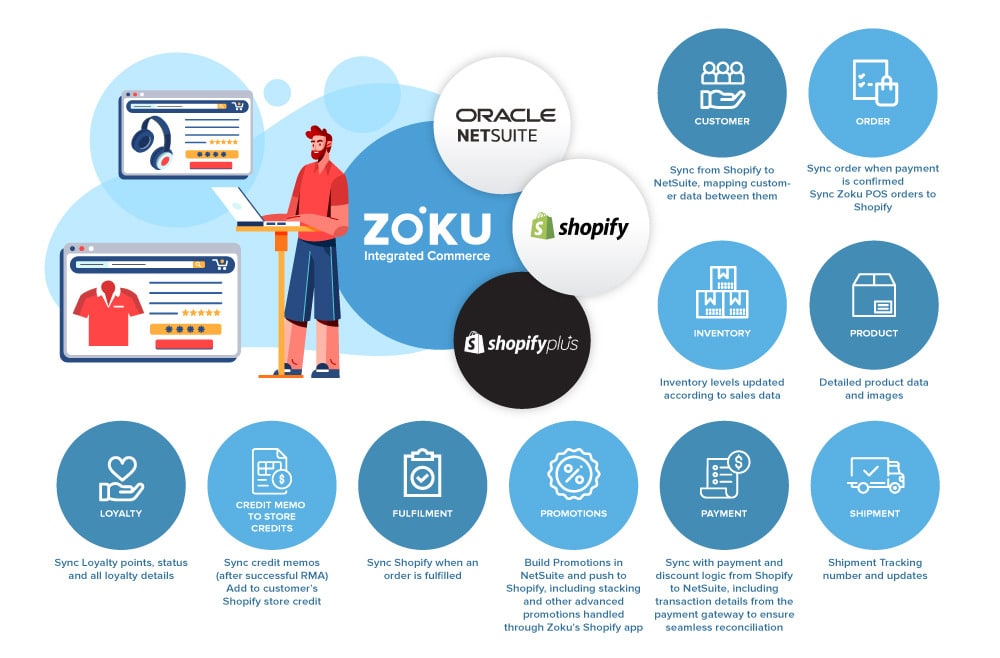
Zoku POS for NetSuite is a point-of-sale system designed to connect in-store retail operations directly with Oracle NetSuite ERP while integrating with ecommerce platforms such as Shopify.
This ERP-aligned approach enables real-time inventory visibility, accurate financial posting, and scalable multi-location store execution.
POS as Core Operational Infrastructure
Modern POS is no longer just checkout.
It is the operational hub coordinating customer data, inventory management, sales orders, fulfillment workflows, and financial posting in real time.
If POS cannot coordinate retail operations across stores, inventory, customers, and finance in real time, long-term scalability is limited regardless of checkout simplicity.
Limits of Ecommerce-Governed POS
Shopify POS is structured around the Shopify ecommerce data model governing products, customers, transactions, and inventory. This approach works well for ecommerce-first retailers with limited store counts and simple fulfillment needs.
As retailers scale, operational requirements expand to include ERP financial control, real-time inventory synchronization, unified reporting, and fulfillment orchestration across locations.
When ecommerce governs store operations, retailers may encounter fragmented inventory visibility, delayed synchronization with NetSuite, reconciliation workload between systems, and constrained scalability.
Hardware Requirements at Retail Scale
Shopify POS primarily operates on mobile and tablet devices rather than workstation-based environments common in higher-volume retail.
As store networks grow, retailers typically require fixed checkout lanes, high-speed barcode scanning, integrated peripherals, durable terminals for continuous use, and standardized deployment across locations.
In these environments, tablet-only POS can become an operational bottleneck.
Offline Resilience and Revenue Protection
When connectivity drops, POS limitations can impact customer lookup, payment processing, and transaction certainty.
For retailers operating in malls, airports, pop-ups, and peak trading environments, downtime directly affects revenue, customer experience, and financial reconciliation.
Retail-grade POS must maintain operational continuity even during network disruption.
NetSuite and Shopify Coordination
Retailers running NetSuite with Shopify ecommerce commonly rely on synchronization layers to connect customer data, orders, and inventory while supporting fulfillment and financial reconciliation.
Synchronization delays, data conflicts, and manual reconciliation effort can emerge as operations scale.
For growing retailers, POS architecture becomes critical in ensuring accurate, real-time coordination between stores, ecommerce, and ERP.
How Zoku Enables Scalable NetSuite Retail Operations
Zoku POS for NetSuite is designed for retailers where NetSuite serves as the system of record for financials, inventory, customer data, and order processing.
Zoku enables:
This ERP-aligned model supports scalable, multi-location retail growth.
Unlocking Retail AI with Unified NetSuite Data
Retail AI depends on clean, unified transaction-level data across customers, inventory, orders, and financials.
When store and ecommerce activity resolve inside NetSuite, retailers can fully utilize NetSuite AI for:
Fragmented or delayed data from disconnected systems limits AI effectiveness.
A unified ERP data foundation allows AI to operate across the entire retail business in real time.
Strategic Comparison
| Dimensions | Shopify POS | Zoku POS for NetSuite |
|---|---|---|
| Core architecture | Ecommerce-centric | ERP-aligned retail operations |
| Hardware model | Tablet-focused | Flexible store infrastructure |
| Offline resilience | Limited | Operational continuity |
| Inventory synchronization | Connector-dependent | Real-time NetSuite visibility |
| Commerce flexibility | Shopify-locked | Multi-platform integration |
| Multi-location scalability | Constrained | Enterprise-ready |
| AI readiness | Fragmented data | Unified ERP data |
Frequently Asked Questions
Shopify POS can support basic store operations connected to NetSuite through synchronization or connector-based integration. As retailers scale across multiple locations with more complex inventory management, sales order processing, shipping costs, and financial data reconciliation, many require a point-of-sale system aligned directly with NetSuite ERP and core business operations.
A POS system designed for NetSuite can automate order processing, maintain accurate inventory levels, reduce manual data entry, support reliable data exports, and provide consistent real-time visibility across ecommerce, stores, and mobile apps.
Accurate AI insights depend on unified operational data within NetSuite across customers, inventory management, transactions, fulfillment, and financial reporting. When POS, ecommerce, and business operations resolve inside NetSuite ERP, retailers can apply AI-driven forecasting, optimization, and analytics without reconciliation delays or data conflicts.