

Oracle NetSuite has announced the end of life of NetSuite POS Cloud Service (NSPOS) and SuiteCommerce InStore (SCIS). Both solutions are scheduled to reach end of life on January 31, 2029.
For businesses currently running these systems, operations can continue during the transition period.
However, POS migrations rarely happen overnight. Hardware validation, integrations, data migration, staff training, and rollout across locations all require planning.
For many organizations, replacing SCIS or NSPOS is also an opportunity to reconsider how store operations, inventory management, payments, and commerce channels connect to NetSuite.
The Architectural Decision: Connector POS vs NetSuite-Aligned Platforms
When evaluating replacements for SCIS or NSPOS, the most important question is how the POS platform interacts with NetSuite.
Many POS solutions integrate with NetSuite through connectors or middleware, where the POS operates as a separate system and synchronizes transactions and inventory data with NetSuite.
On paper this appears straightforward.
In practice connectors often become the most fragile part of the architecture.
Consultants who have supported these environments frequently describe the same operational pattern: synchronization delays, inventory discrepancies between systems, and time spent reconciling transactions when integrations fail.
Sometimes the symptoms are small but frustrating. A store sells the last item in stock but the web store still shows it available because the connector has not synchronized inventory yet.
That “ghost inventory” problem appears frequently in disconnected POS environments.
When operational data is maintained across multiple systems, organizations can also encounter broader issues such as financial reconciliation discrepancies, fragmented customer records, inconsistent promotions across channels, and delayed operational reporting.
These challenges are widely recognized in enterprise and retail technology architecture. Analysts have long highlighted the risks created by fragmented operational data across disconnected systems and the operational complexity this introduces for multi-channel retailers.
Gartner research on enterprise data governance and master data management emphasizes the importance of maintaining a single source of truth for operational data across enterprise systems. Similarly, Forrester research on unified commerce architectures highlights the importance of maintaining consistent operational data across channels and enterprise systems in order to support reliable inventory visibility, promotions, and financial reporting.
For companies running NetSuite as their ERP, maintaining a single source of truth for inventory, customers, and transactions becomes essential.
Data integrity is not optional.
Commerce Architecture Models
Modern commerce architectures generally fall into three models.
Connector POS Architecture
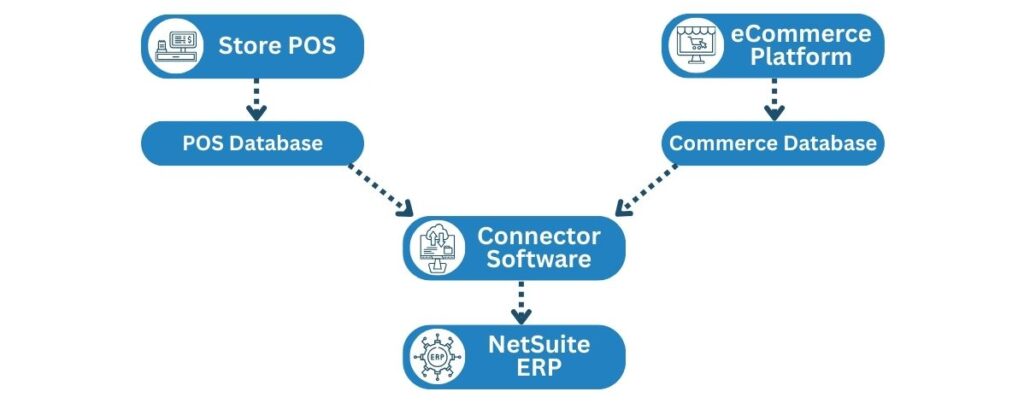
In this model, POS systems and commerce platforms operate as separate applications with their own operational databases. Connector software is used to synchronize transactions, inventory, and customer data with NetSuite.
While this approach can work, it introduces additional integration layers that must constantly synchronize operational data between systems. When synchronization delays or errors occur, organizations can experience inventory discrepancies, reconciliation challenges, and operational reporting delays.
Commerce Platform as System of Record
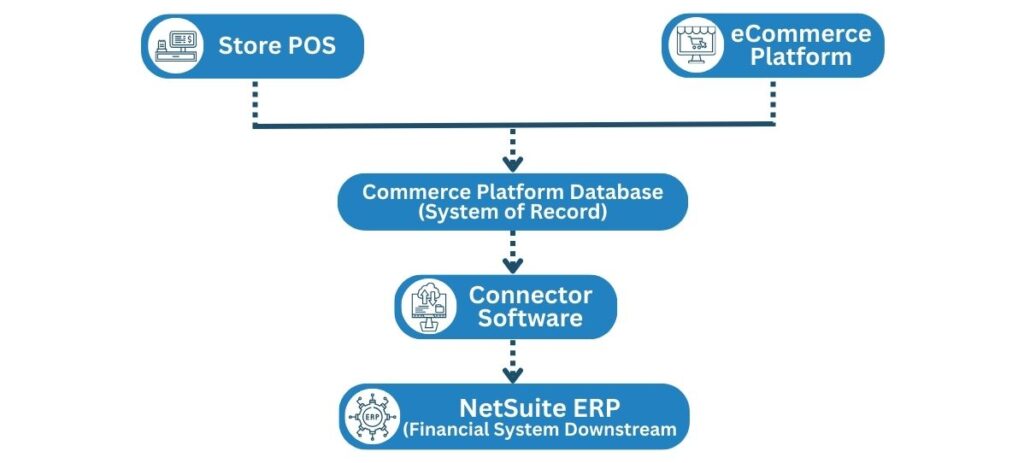
In this architecture, the commerce platform manages operational data such as products, inventory, customers, and transactions across both stores and eCommerce channels.
NetSuite typically receives synchronized or summarized transaction data from the commerce platform through connector software for financial processing and reporting.
This model is common when organizations adopt a commerce platform that becomes the operational center for retail and eCommerce channels.
However, when operational data originates primarily within the commerce platform, ERP systems often receive transactions and inventory updates after they occur rather than originating them. As businesses grow and operational complexity increases across stores, warehouses, and distribution networks, organizations must carefully manage reconciliation between commerce operations and ERP processes.
Enterprise System of Record Architecture
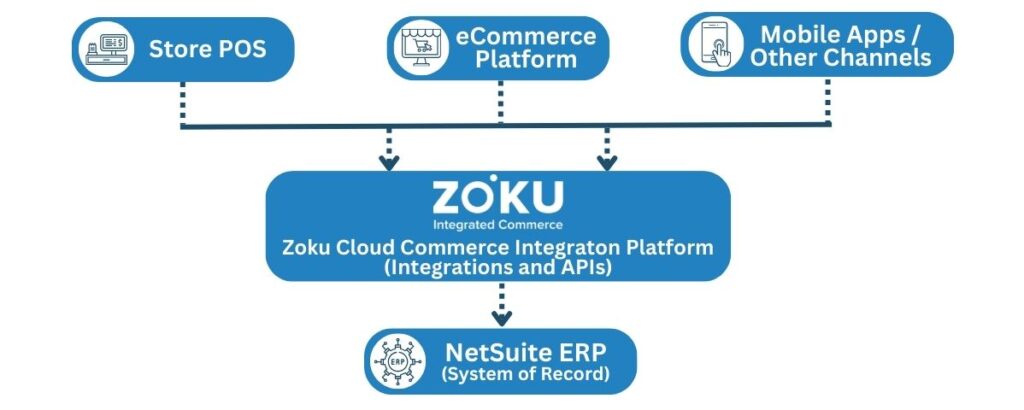
In an ERP centered architecture, NetSuite remains the authoritative system of record for products, customers, inventory, and transactions.
Store systems, eCommerce platforms, and other commerce interfaces connect through an integration layer that allows these channels to interact with NetSuite while maintaining a consistent operational data model.
This approach allows organizations to support multiple commerce channels while keeping operational data centralized within the ERP system. For businesses running NetSuite as their core platform, this architecture helps maintain accurate inventory visibility, financial integrity, and consistent reporting across retail, eCommerce, and wholesale operations.
Why Architecture Matters: Connector POS vs Fully Native POS
Organizations replacing SCIS or NSPOS typically encounter two types of POS architecture.
Some platforms operate as external systems connected to NetSuite through connectors or middleware.
Other solutions operate entirely inside the NetSuite environment, where the POS interface and application logic run directly within the ERP.
This fully native model has been used by solutions such as SuiteCommerce InStore (SCIS), NetSuite POS (NSPOS), and some other NetSuite SuiteApps.
Both approaches have trade offs.
Connector architectures introduce synchronization risks and reconciliation challenges.
Fully native POS solutions can also face limitations because the entire store application runs within the ERP application layer. This can affect areas such as user interface responsiveness, device flexibility, and integration with external commerce systems.
As commerce technology has evolved, many platforms across the industry have moved toward modular architectures that separate operational interfaces from the core system of record.
Evolution Toward Modular Commerce Architectures
Zoku follows this modular architecture around NetSuite.
The platform combines NetSuite SuiteApps such as Zoku POS and Zoku Inventory Management with the Zoku Cloud Commerce Integration Platform and client applications used in store environments.
This architecture allows NetSuite to remain the system of record for products, customers, inventory, and transactions while enabling flexible store interfaces and integrations with external commerce systems.
Through the Zoku Cloud Commerce Integration Platform, businesses can connect eCommerce platforms such as Shopify, Magento or Adobe Commerce, WooCommerce, and SuiteCommerce Advanced as part of the broader commerce environment.
Why the Data Model Matters More in the AI Era
Maintaining NetSuite as the operational system of record is becoming even more important as analytics and AI capabilities become central to modern ERP platforms.
NetSuite’s forecasting, analytics, and emerging AI capabilities rely on high quality operational data.
When sales transactions, inventory movements, and customer interactions originate directly inside NetSuite, these capabilities can analyze a complete dataset.
When commerce data originates in external systems and is synchronized into NetSuite later, the ERP often receives only summarized information rather than the full operational context.
Over time this can limit the value organizations obtain from NetSuite’s analytics and AI driven insights.
Flexible Payment Infrastructure
Zoku works with strong, established payment platform partners that provide everything businesses need to process payments across retail, food and beverage, and wholesale distribution environments.
These partners support modern payment methods including card payments, contactless transactions, and digital wallets. Zoku deploys and supports these payment platforms as part of the overall solution so payment processing remains reliable and fully integrated with operational workflows.
Because these platforms operate at global scale, businesses are often able to reduce payment processing costs and secure better transaction rates compared to their existing payment setup.
What Is Zoku
Zoku is developed by a NetSuite SuiteCloud Development Network partner and provides a unified commerce platform designed to work closely with NetSuite.
The platform includes NetSuite SuiteApps such as Zoku POS and Zoku Inventory Management which extend NetSuite to support store operations and inventory workflows across multi location environments.
Zoku also provides the Zoku Cloud Commerce Integration Platform for NetSuite, which enables integrations and extensions for eCommerce platforms including Shopify, Magento or Adobe Commerce, WooCommerce, and SuiteCommerce Advanced.
Through this platform additional commerce systems can also be connected into the NetSuite ecosystem as business requirements evolve.
Why NetSuite Operators Are Evaluating Zoku
Zoku has supported multiple successful migrations from SCIS and NSPOS environments, helping organizations transition their store operations to a NetSuite aligned architecture while preserving NetSuite data structures.
Zoku has also been adopted by companies moving away from POS platforms such as LightSpeed, Shopify POS, and Square when businesses outgrow disconnected POS environments and require deeper integration with NetSuite.
In many of these projects the goal is not simply replacing the POS.
It is simplifying the overall commerce architecture.
Consultants often describe the benefit in practical terms. Fewer integration layers mean fewer things that can break after go live.
Planning a POS Migration Strategy
Although the official end of life date is several years away, organizations should begin evaluating options early.
Replacing a POS system is not just a technical migration. It is an opportunity for businesses to rethink their retail and commerce strategy for the next decade, as modern Omni-POS platforms support far more than basic sales transactions.
Deployment timelines depend on the scope of the project.
Many customers can go live within a few weeks when store operations can be configured using Zoku’s capabilities.
More complex environments may require additional time when projects involve custom workflows, integrations with third party commerce systems, or phased rollout across multiple locations.
Frequently Asked Questions
Yes. Zoku supports the core capabilities required by businesses currently using SCIS or NSPOS, including store sales, returns, promotions, inventory visibility, and customer management.
Zoku has already supported multiple successful migrations from SCIS and NSPOS environments while helping businesses overcome operational challenges they experienced with their previous POS solutions.